TL;DR
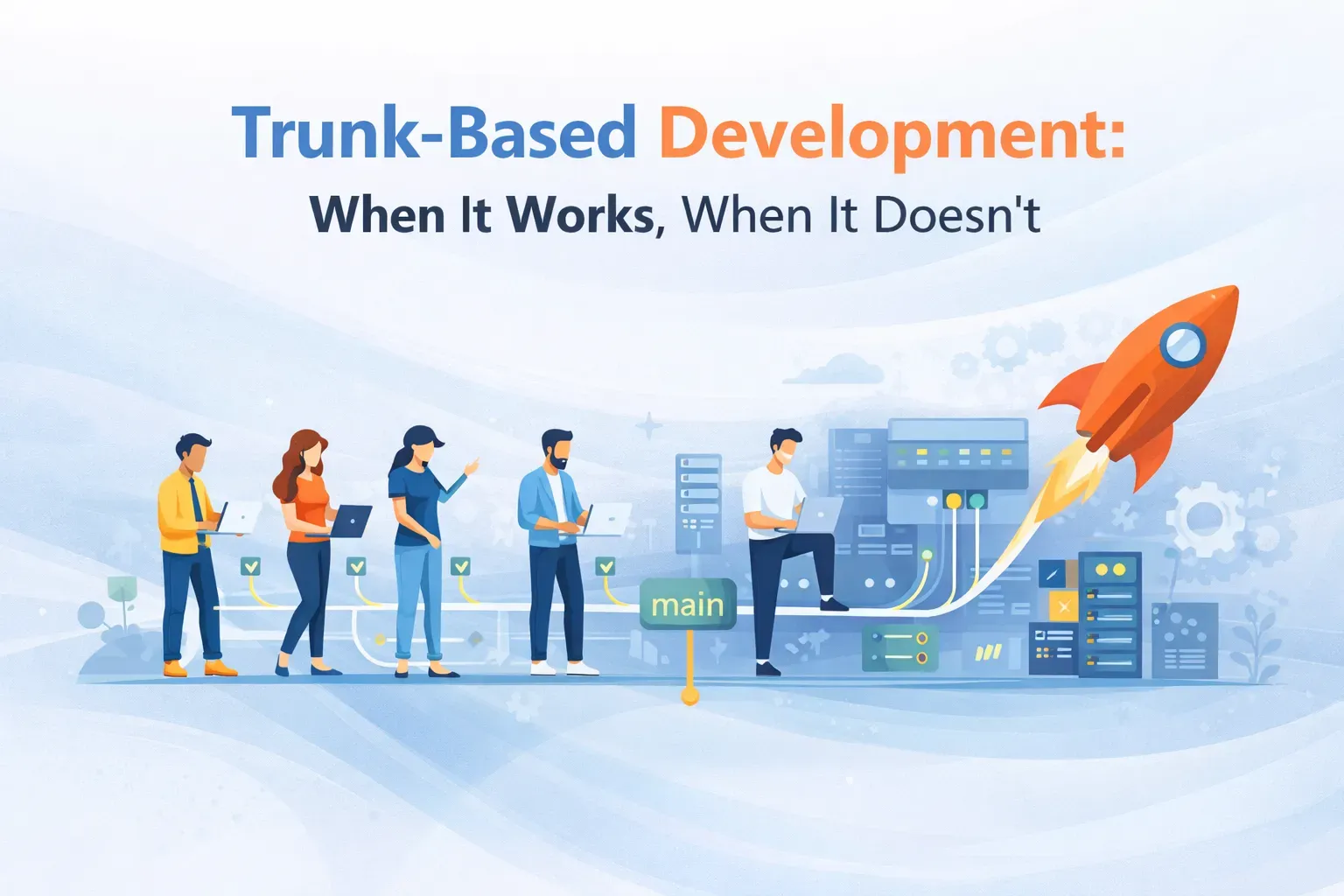
Trunk-based development (TBD) is a source-control strategy where developers integrate into a single main branch frequently (at least daily), avoiding long-lived feature branches.
It works best with:
- Fast CI
- Strong automated tests
- Small batch sizes
- Feature flags
- A disciplined engineering culture
It struggles when:
- Tests are weak or slow
- CI is unreliable
- Teams are large but poorly coordinated
- Releases require rigid, manual gating
Used correctly, TBD removes merge pain and accelerates delivery. Used prematurely, it exposes every weakness in your system.
What Is Trunk-Based Development?
Trunk-based development means all developers integrate small changes into a single shared branch (main or trunk)
continuously.
Key characteristics:
- No long-lived feature branches
- Integration happens daily (or more often)
- Trunk is always releasable
- Incomplete work is hidden using feature flags
Instead of delaying integration, TBD makes integration constant. This eliminates the traditional “merge phase” entirely.
If integration is painful, you’re doing it too late.
Why Feature Branching Fails at Scale
Long-lived branches introduce:
- Large, risky merges
- Late discovery of conflicts
- Delayed feedback
- Unpredictable release cycles
Trunk-based development replaces this with continuous reconciliation, where conflicts are small, local, and resolved immediately.
Prerequisites for Trunk-Based Development
Trunk-based development is not forgiving. It assumes engineering maturity.
Non-negotiables
1. Fast CI
- Every commit triggers automated tests
- Feedback in minutes, not hours
- Slow CI kills merge frequency
2. Strong Automated Testing
- Unit and integration tests are mandatory
mainmust stay green- Broken builds are fixed immediately
3. Small Batch Discipline
- Work must be sliceable into daily merges
- Requires product, design, and engineering alignment
4. Feature Flags
- Merge early, release later
- Decouple deployment from exposure
- Flags must be actively cleaned up
5. Team Culture
- Shared ownership of
main - Lightweight, fast reviews
- High trust and accountability
Team Size and Scale
Small–Mid Teams (2–10)
- Ideal fit
- Low coordination overhead
- Extremely fast iteration
Large Teams / Enterprises
Trunk-based development can scale, but only with:
- Exceptional CI performance
- Strong ownership boundaries
- Heavy automation
- Often a monorepo strategy
Google and Meta succeed here because they invested deeply in tooling, not because TBD is easy at scale.
Most enterprises adopt hybrid approaches:
- Trunk-based day-to-day
- Short-lived release branches
- Feature flags for rollout control
When Trunk-Based Development Is a Good Fit
Adopt TBD when:
- You deploy frequently
- You want to eliminate merge hell
- You value fast feedback loops
- You practice CI/CD seriously
- You prefer continuous refactoring
DORA research consistently shows high-performing teams:
- Merge daily or more
- Work in small batches
- Use trunk-based development
This is correlation backed by years of data.
When Not to Use Trunk-Based Development (Yet)
Avoid or delay TBD if:
- Test coverage is poor
- CI is slow or flaky
- The codebase is fragile
- Releases require heavy manual approval
- Teams rely on long isolated work streams
Trunk-based development amplifies reality.
If your system can’t tolerate frequent change, TBD will expose that instantly.
Fix foundations first:
- Test automation
- Build performance
- Modularisation
- Deployment automation
The Core Trade-Off
Trunk-based development trades:
Branching safety
⬇
Engineering discipline
Git stops being your safety net.
Automation, tests, and culture take its place.
Teams that make this shift tend to outperform those that don’t.
Final Take
Trunk-based development is not a Git trick, it’s an organisational capability.
If you want:
- Faster delivery
- Fewer merges
- Continuous releasability
TBD is one of the highest-leverage practices you can adopt, if you’re ready.
Done right, it doesn’t just change how you branch.
It changes how your team thinks about integration, quality, and ownership.