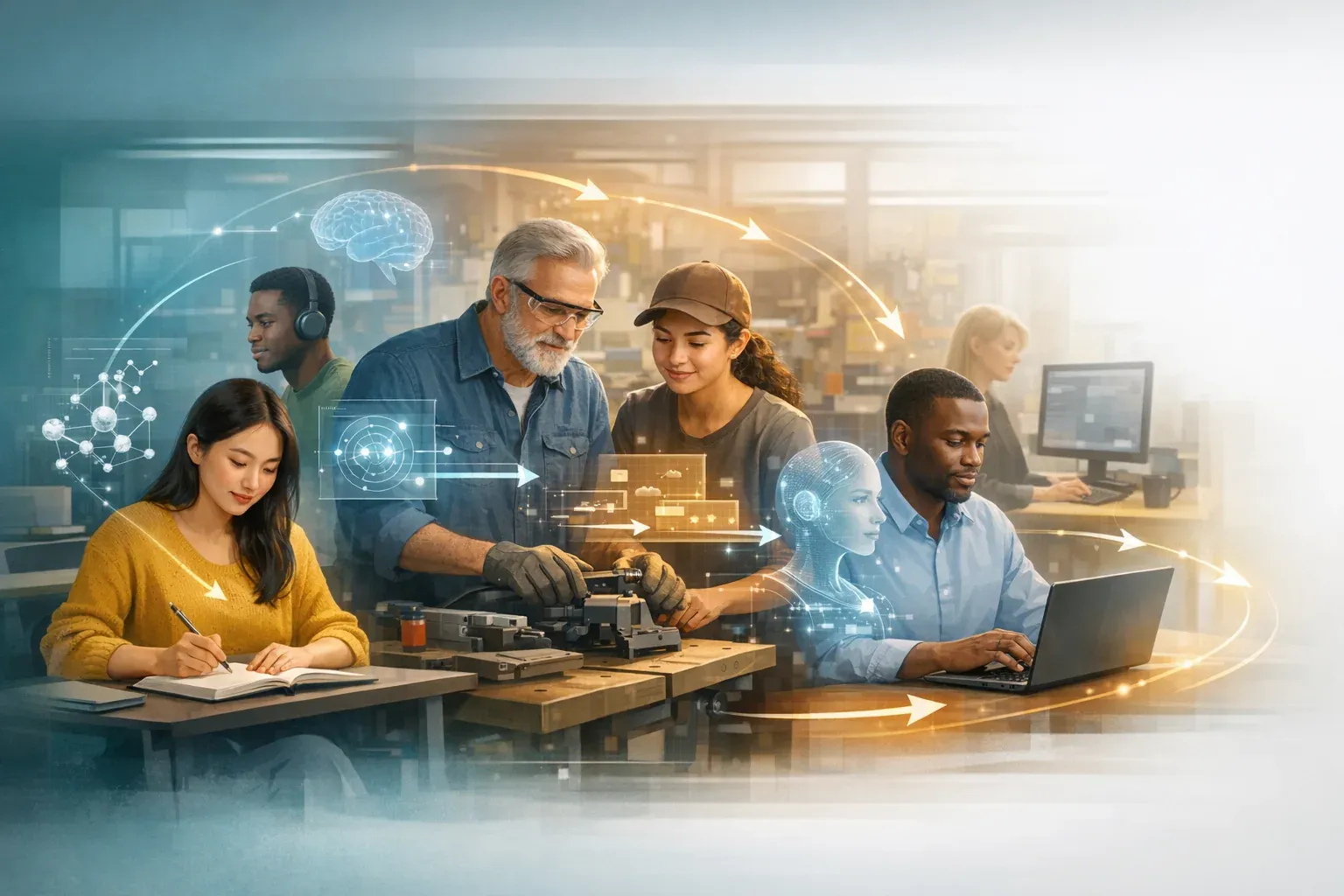
From batch learning to on-demand help
You learned in classrooms at fixed times, from fixed materials, at the speed of the median learner. Training at work was similar: expensive courses, annual refreshers, and a lot of “learn this now because we scheduled it”, regardless of whether you needed the skill that week.
AI changes that constraint. We now have systems that can explain, test, adapt, and coach in real time, precisely when a person is stuck. My view is simple: on-demand learning will compound into a smarter population over time, not because AI replaces teachers or experts, but because it makes high-quality feedback much more available.
Why this matters more than another productivity story
Most AI commentary still treats models as automation tools. That is only half the picture.
The bigger long-term effect is educational: each interaction can become a micro-lesson. Ask for help writing a SQL query, and you get an answer plus explanation. Ask how to fix a deployment pipeline, and you can request alternatives, trade-offs, and a runnable plan. This is not just “doing work faster”; it is learning while doing.
If millions of people do that daily, capability growth becomes continuous rather than episodic.
What recent studies show (the supportive case)
The evidence is still early, but several recent studies point in the same direction.
-
AI tutoring can produce meaningful learning gains quickly.
A World Bank Policy Research Working Paper from 20 May 2025 on a randomised controlled trial in Nigeria reported effects of around 0.23 SD in English, 0.10 SD in AI literacy, and 0.31 SD combined after a six-week after-school programme, with benefits still detectable weeks later. -
AI support can lift lower-performing students and reduce gaps.
The working paper “Tutor CoPilot” (EdWorkingPaper, 25 November 2025) studied 2,712 students and 900 tutors. It reports higher student pass rates with the largest gains when lower-rated tutors used the assistant. That is exactly what you want from scalable learning tech: stronger floor performance, not just elite gains. -
In workplace settings, AI can function like real-time training.
NBER paper w31161 (“Generative AI at Work”) measured 5,179 customer support agents and found roughly 14% productivity gains with much larger gains for novice and lower-skilled workers. That pattern suggests transfer of tacit expert practices at the moment of need. -
Domain-specific education can improve practical performance.
A 2025 randomised trial in JMIR Medical Education (dental training) found that students using ChatGPT-supported instruction performed better on practical tasks and reported lower cognitive load than the control group.
None of these studies proves that AI automatically makes everyone smarter. Together, though, they do support a strong claim: on-demand AI support can improve learning outcomes and speed skill acquisition across school and work contexts.
The feed-forward effect: why this could compound
If access to feedback gets cheaper and more immediate, learning loops tighten:
- More attempts per day
- Faster error correction
- Lower friction to start unfamiliar tasks
- Better retention through context-specific practice
That creates a feed-forward system. Better tools lead to more learning opportunities; more learning increases baseline skill; higher baseline skill lets people ask better questions; better questions extract more value from the tools.
In other words, AI does not just answer questions, it can raise the quality of future questions.
The strongest counterarguments (and they matter)
There are serious risks, and ignoring them would be naïve.
-
Performance can drop when learners outsource thinking.
A 2025 PNAS study on AI-assisted maths learning found average performance declines and increased overconfidence when students relied on GPT without proper scaffolding. -
Engagement may decrease even when grades rise.
The 2025 “GPT Surprise” preprint reports improved assignment performance for some groups, but lower classroom participation when GPT-4 access was provided. Better outputs are not the same as deeper learning habits. -
Weak implementation can widen inequality.
Students and workers with better devices, connectivity, prompting skills, or supervision may pull further ahead. “AI for everyone” is not automatic; delivery quality and access conditions still determine outcomes. -
Accuracy and epistemic trust remain unresolved.
Hallucinations, confident errors, and fabricated citations can hard-code misconceptions unless verification is built into the learning workflow.
These are not edge cases. They are design constraints.
The practical stance: optimistic, but strict
The right conclusion is neither techno-utopian nor anti-AI.
If we want AI-enabled education and training to make people genuinely smarter, we should design for:
- Tutor mode over answer mode: explanation, hints, and staged reasoning before final answers.
- Verification habits: require source checks and cross-validation in high-stakes domains.
- Human oversight where it matters: teachers, mentors, and managers focus on judgment and misconceptions.
- Equity by default: invest in access, not just model capability.
- Assessment redesign: test transfer, reasoning, and application, not just output production.
Conclusion
My opinion is that AI is already enabling education and training on demand, and that this is one of its most important civilisational effects.
Will everyone become smarter automatically? No.
Will we see smarter populations if we deploy these systems with sound pedagogy, guardrails, and equitable access? Very likely.
The decisive question is no longer “can AI teach?”.
It is “can we build institutions that use AI to help people think better, not just finish faster?”.
References
- World Bank Policy Research Working Paper 11125: From Chalkboards to Chatbots (2025)
https://hdl.handle.net/10986/43212 - EdWorkingPaper: Tutor CoPilot (2025)
https://www.edworkingpapers.com/ai24-1054 - NBER: Generative AI at Work (w31161)
https://www.nber.org/papers/w31161 - JMIR Medical Education: ChatGPT in practical dental training (2025)
https://www.jmir.org/2025/1/e68538/ - PNAS: Can a GPT tutor improve undergraduate learning? (2025)
https://doi.org/10.1073/pnas.2422633122 - arXiv: GPT Surprise (2025 preprint)
https://arxiv.org/abs/2506.07037