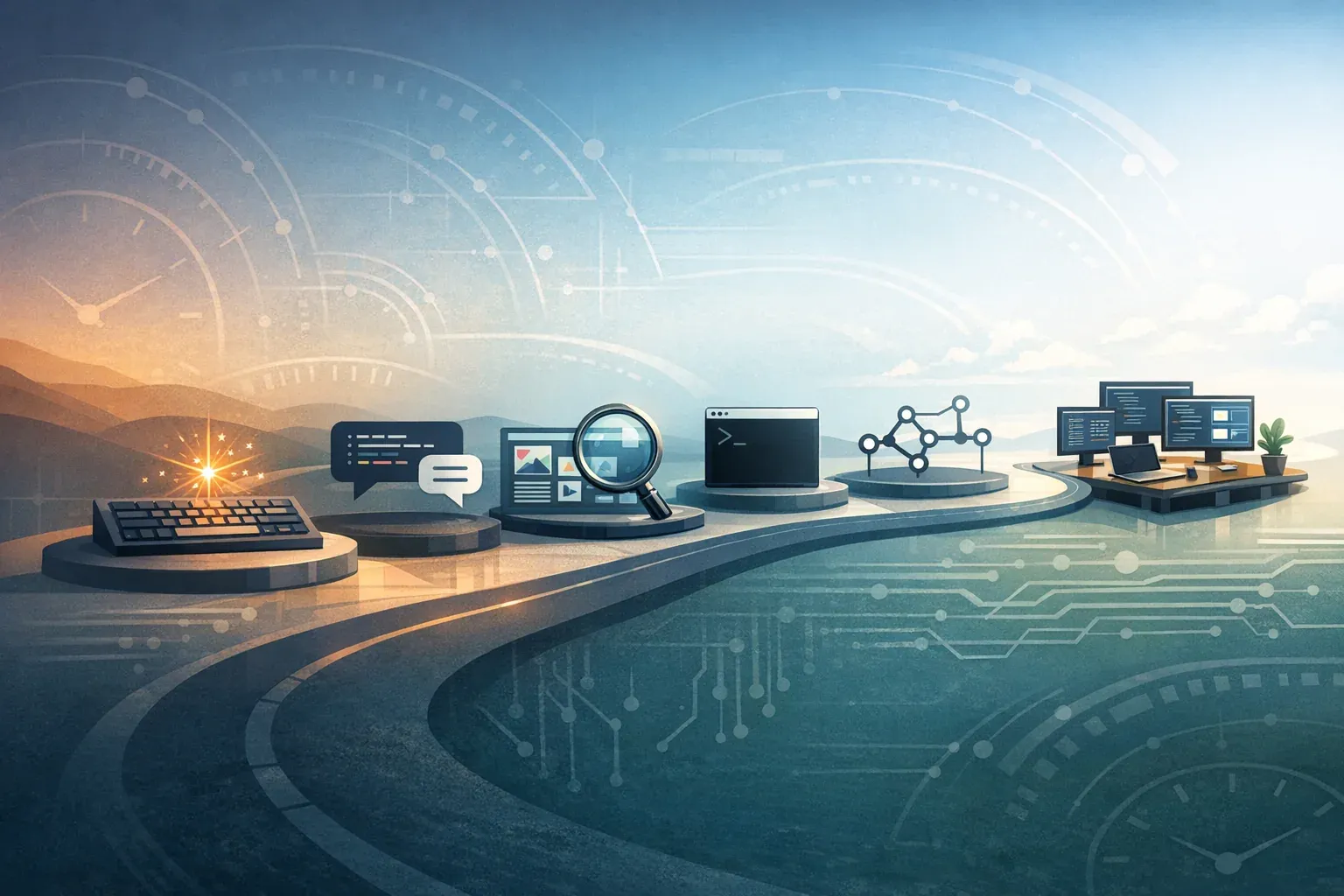
AI coding tools have moved fast. In five years, I went from basic autocomplete to terminal-native agents and desktop co-working workflows.
This timeline is not about launch dates or market share. It is about adoption dates in my own workflow and what each tool class actually changed in day-to-day development.
Timeline at a Glance
| Date | Tool | What Changed for Me |
|---|---|---|
| 2021-09 | GitHub Copilot (Beta) | First meaningful inline autocomplete for production code. |
| 2021-10 | JetBrains Copilot IDE Plugin | Brought AI suggestions into my main IDE flow. |
| 2022-11 | GPT-3.5 / ChatGPT | Natural-language coding help became mainstream and kicked off the global AI race. |
| 2023 | Broad model improvements | Better vision/image generation but limited direct coding impact for my workflow. |
| 2023-09 | GPT-4 Vision | Made screenshot-driven debugging and UI interpretation more practical. |
| 2023-12 | Gemini | Added a serious alternative model family to evaluate. |
| 2024-08 | JetBrains Grazie (Preview) | Proof reading and correcting my dsylexic writing via AI optimised for technical writing. |
| 2025-04 | JetBrains Junie (Preview) | Shift toward more agent-like assistance inside the IDE. |
| 2025-04 | GitHub Copilot code review | PR automated code reviews. |
| 2025-04 | Codex CLI | Strong improvement in terminal-native, repo-level coding tasks. |
| 2025-05 | Claude Code | Better long-context coding workflows from the command line. |
| 2025-06 | Gemini CLI | CLI pattern became a multi-vendor reality, not a one-tool experiment. |
| 2025-10 | Agentic coding workflows | Shifted from one-shot prompts to multi-step execution loops across real repositories. |
| 2025-11 | Antigravity | Reinforced the trend toward agentic, task-oriented development workflows. |
| 2025-12 | Reusable skills and playbooks | Started formalising repeatable coding tasks into reusable skill files and checklists. |
| 2026-01 | Claude Co-Work | More persistent, collaboration-style AI knowledge work beyond coding. |
| 2026-01 | Skills-first sessions | Combined agentic tools with explicit skills so outputs stayed consistent over long tasks. |
| 2026-02 | Codex app (macOS) | Combined desktop UX with terminal-grade coding workflow and context. |
| 2026-02 | Codex automations | Scheduled recurring AI tasks and reports, turning one-off workflows into repeatable operations. |
Phase 1 (2021 to 2022): Autocomplete to Conversational Coding
The first jump was straightforward. Copilot reduced typing and helped with boilerplate, but the real shift came with ChatGPT in late 2022.
Once conversational prompts became mainstream, AI stopped being only an “inline suggestion” tool. It became a second interface for coding itself: asking for patterns, quick scaffolds, debugging ideas, and alternative implementations.
At this stage, quality control stayed entirely human. The speed gain was real, but so was the need to validate everything.
Phase 2 (2023 to 2024): Better Models, Modest Coding Delta
In 2023 and 2024, models improved rapidly. Vision support and multimodal inputs were impressive, especially for UI and documentation tasks.
For pure software engineering output though, my biggest gains were still from disciplined use of existing tools, not from every new model release. The gains were incremental rather than transformational.
This was also the period where it became obvious that model quality alone is not enough. Workflow integration matters more than benchmark headlines.
Phase 3 (2025): The CLI and Agentic Workflow Inflection
2025 felt like a structural shift.
Instead of chat-first workflows, I started using terminal-first tools that could work directly against a repository: editing files, running commands, and iterating through feedback loops faster. By late 2025, this became properly agentic coding: tools handling multi-step tasks end-to-end, rather than just returning a code snippet for copy/paste.
The key difference was not just “better answers”. It was tighter execution loops:
- Change code
- Run checks
- Inspect output
- Refine immediately
Once that loop became smooth, productivity gains were more durable and easier to repeat across tasks.
Phase 4 (early 2026): Toward Co-Working Interfaces
In early 2026, tools started feeling less like assistants and more like co-working systems: persistent context, richer desktop interfaces, and better support for longer-running coding threads.
At the same time, skills became a major part of reliability. Reusable skill files and playbooks made agentic runs more consistent by encoding expectations, constraints, and repeatable workflows.
By February 2026, automations added the next layer. Instead of manually kicking off the same checks and summaries, recurring Codex runs could execute these workflows on a schedule and deliver results as inbox items.
The improvement here is operational. It is about keeping momentum across multiple tasks with predictable quality, not just generating one-off code snippets.
What Actually Moved the Needle
Looking back, these factors mattered most:
- Repository-aware workflows over isolated chat windows
- Terminal integration over copy/paste prompting
- Fast validate/fix cycles (tests, linting, type checks)
- Strong diff review habits before accepting generated changes
- Better context retention across a longer task lifecycle
- Reusable skills for common workflows, so outputs stayed structured and repeatable
- Automations for recurring tasks, so high-value routines happened without manual prompting
What Did Not Matter as Much
Some improvements were useful, but less impactful for core coding throughput:
- New model announcements without workflow integration
- Generic “write this function” prompting with no project context
- Feature novelty that did not reduce validation effort
How I Evaluate New AI Coding Tools Now
I use a simple checklist before adopting anything new:
- Does it work directly against my real repository?
- Can it run and interpret local checks, not just generate code?
- Does it reduce context switching between IDE, terminal, and docs?
- Is it easy to review and control every suggested change?
- Does performance hold up on long, multi-file tasks?
If a tool fails most of those checks, it may still be interesting, but it is unlikely to stick in my daily workflow.
Final Thoughts
From 2021 to 2026, the story has been less about “which model is best” and more about “which workflow compounds”.
Autocomplete was the start. Conversational coding widened access. CLI agents and co-working interfaces radically changed the execution loop. The recent Agents and Skills have enabled the biggest day-to-day productivity gains for me now, it truly feels like I have superpowers.