Introduction
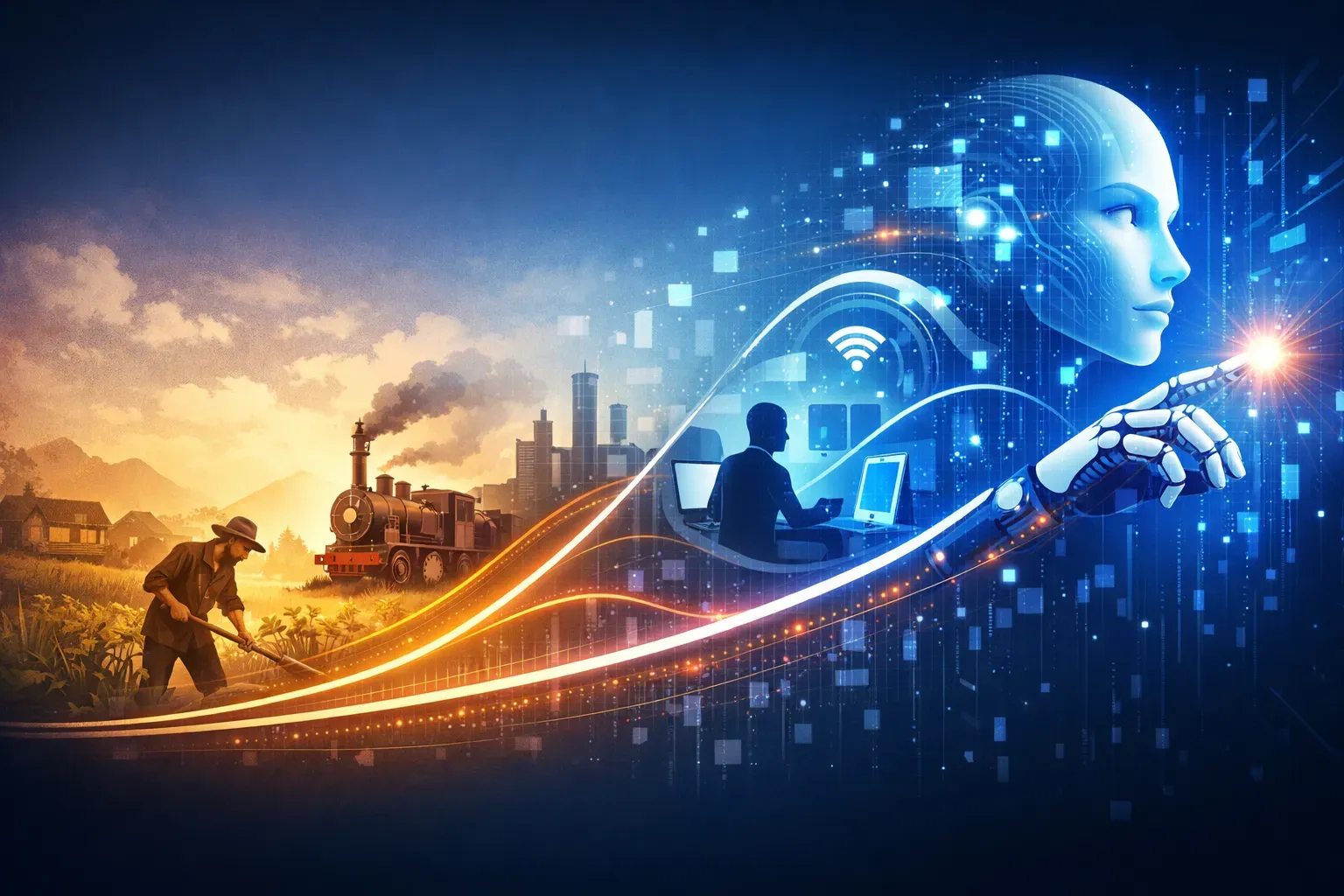
Human history is punctuated by moments when the rules of society, work, and wealth abruptly change. We call these moments revolutions. What’s striking, looking back, is not just their impact, but their acceleration.
Each successive revolution has unfolded faster than the one before it, affecting more people, in more places, with less time to adapt. The current AI revolution is different again: it doesn’t merely speed up productivity, it accelerates change itself.
This article explores four major revolutions, agricultural, industrial, digital, and AI, and argues that AI may be the most disruptive shift humanity has faced so far.
1. The Agricultural Revolution: Millennia of Adjustment
Approximate duration: ~10,000 years
Duration: 10,000 BC - 1800 AD
The agricultural revolution transformed humanity from nomadic hunter‑gatherers into settled farming societies. Its consequences were profound: food surplus, population growth, property ownership, class systems, and the first states.
Yet it unfolded so slowly that no single generation experienced it as upheaval. Knowledge, customs, and social structures evolved organically over centuries.
Why speed mattered
- Skills were transmitted generationally
- Social norms evolved gradually
- Institutions had time to stabilise
Change was existential, but not destabilising.
Agrarian / Pre-Industrial Societies were included in this grouping.
2. The Industrial Revolution: A Shock Within a Lifetime
Approximate duration: ~150 years
Duration: 1760–1914
The industrial revolution compressed transformation into a handful of generations. Steam power, mechanisation, electricity, factories, and urbanisation redefined work, migration, and wealth.
For the first time, large numbers of people experienced:
- Skill obsolescence within their own careers
- Mass urbanisation
- Dangerous labour conditions before regulation existed
Wealth effects
- Capital ownership outpaced labour income
- Extreme early inequality
- Eventual creation of labour laws and welfare states
Institutions lagged technology but eventually caught up.
3. The Digital & Web Revolution: Decades, Not Centuries
Approximate duration: ~60 years
Duration so far: 1950s–2000s
The digital revolution unfolded within a single working lifetime. Semiconductors, Personal computers, The internet/web, Software-driven productivity, and smartphones reshaped communication, commerce, and culture.
Whole industries vanished or transformed rapidly:
- Print media
- Travel agencies
- Retail
- Recorded music
A key shift
Unlike the industrial era, disruption now occurred globally and simultaneously. Platforms scaled instantly, producing winner‑takes‑most outcomes.
Wealth effects
- Rapid concentration among tech platforms
- Productivity gains unevenly distributed
- Increasing precarity for mid‑skill knowledge workers
4. The AI Revolution: Compression to Years, or Months
Approx. start: debated (2010s–2020s)
Duration: unknown, possibly <20 years for major disruption
AI represents a qualitative shift. Previous revolutions replaced muscle, distance, or access to information. AI replaces cognitive labour itself. While initial progress was slow, it now is advancing exponentially.
AI systems:
- Scale instantly at near‑zero marginal cost
- Improve indirectly through tooling and feedback
- Replicate language, pattern recognition, and planning
This means disruption is no longer bounded by human retraining speed.
Why AI is different
- Knowledge work is no longer scarce
- Productivity gains no longer require proportional human input
- Job displacement can occur globally and near‑simultaneously
Yes, I know AI development started as far back as the 1950s, but it’s the impactful change I want to track, so forgive my timeline shortening.
timeline
    title Major Human Revolutions and Their Duration
    10000 BC : Agricultural (Neolithic) Revolution, ~8,000–9,000 years
    3000 BC : Agrarian / Pre-Industrial Societies, ~4,000–5,000 years
    1760 : Industrial Revolutions, ~150 years
    1960 : Digital / Information Revolution, ~60 years
    2010s : AI / Cognitive Automation Revolution (emerging), 10-15 years so far
The visual pattern is unmistakable: each revolution arrives faster than the last.
The Real Risk: Adaptation Collapse
The danger of AI is not malevolence or consciousness. It is a velocity mismatch.
- Individuals cannot retrain fast enough
- Governments cannot legislate fast enough
- Cultures cannot redefine identity fast enough
This mismatch manifests as:
- Anxiety and burnout
- Political instability
- Reactionary backlash
- Loss of trust in institutions
xychart-beta
    title "Speed of Change vs Human Adaptation"
    x-axis [Agriculture, Industrial, Digital, AI]
    y-axis "Relative Speed"
    bar [1, 5, 20, 100]
Human institutions, education, law, culture, evolve linearly. Technological capability is now exponential.
Why This May Be the Most Disruptive Revolution Yet
AI is the first revolution that:
- Undermines the economic value of thinking itself
- Compresses feedback loops to weeks or days
- Scales globally without physical constraints
In effect, AI does not merely change what we do, it changes how quickly society must reinvent itself.
The Open Question
Every previous revolution increased total wealth, but only after prolonged disruption and inequality.
AI offers:
- Abundance
- Scientific acceleration
- Creativity at an unprecedented scale
But only if societies can:
- Decouple dignity from employment
- Distribute productivity gains
- Redefine the meaning of work and contribution
Conclusion
The defining feature of the AI revolution is not intelligence, but speed.
For the first time, humanity is not merely adapting to change. It is struggling to keep pace with the rate at which change now speeds up itself.
Whether AI becomes a foundation for shared prosperity or a catalyst for fragmentation depends less on the technology and more on how quickly society can respond.